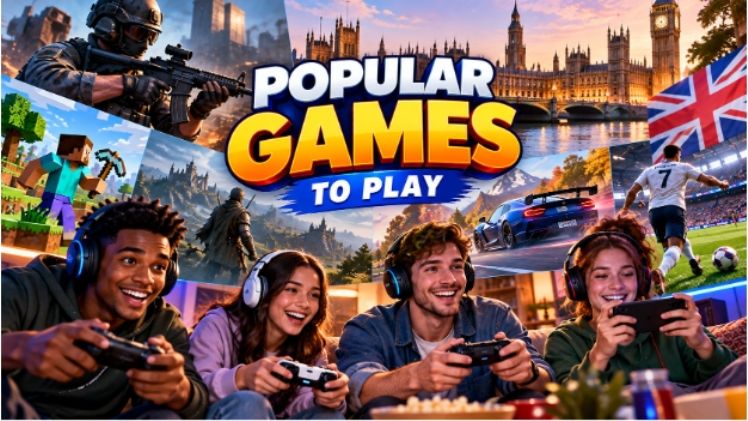
Gaming today covers far more than traditional console releases. Players can move between competitive shooters, open-world adventures, football games, casual mobile titles, strategy games and short browser-based experiences without being tied to one device.
That variety makes it difficult to create a single list of the most popular games to play. A title that works well for a ten-minute mobile session may be completely unsuitable for someone looking for a deep story-driven experience. Competitive players may value skill, ranking systems and fast matchmaking, while casual players often prefer simple controls and short rounds.
PC charts also show how varied current tastes are. Competitive titles such as Counter-Strike 2, Dota 2 and PUBG: BATTLEGROUNDS continue to attract large player numbers alongside newer releases and constantly changing top sellers.
The best approach is therefore to compare games by genre, platform, session length and learning curve rather than trying to identify one universal winner.
What Makes a Game Popular?
Popularity usually comes from several factors working together.
A successful game needs to be easy enough to understand while offering enough depth to keep players interested. Multiplayer titles also benefit from large communities because faster matchmaking and active competition make them easier to return to.
Other important factors include:
- Strong gameplay mechanics
- Regular updates
- Good performance
- Cross-platform support
- Active multiplayer communities
- Clear progression systems
- Reasonable learning curves
- Short and long session options
Accessibility has become especially important. A game available on PC, console and mobile can reach a much larger audience than one restricted to a single platform.
Free-to-play models have also lowered the barrier to entry for many major titles.
Popular Game Categories
Players looking for new games should start with genre rather than popularity charts.
Different categories provide completely different experiences.
Competitive Shooters
Competitive shooters focus on precision, reaction speed and teamwork.
Counter-Strike 2 remains one of the largest examples. It continues to rank among the most-played games on Steam, showing that strong core mechanics can maintain a large audience for years.
Other shooters use larger maps, character abilities or battle royale systems.
These games are best suited to players who enjoy improving mechanical skills and competing against other people rather than following a fixed single-player story.
Battle Royale Games
Battle royale games place many players into the same match and gradually reduce the playable area.
The goal is generally to survive longer than competing players or teams.
PUBG: BATTLEGROUNDS remains a major example and continues to appear among Steam’s most-played titles.
The genre can be attractive because no two rounds develop exactly the same way. Equipment, positioning, opponents and map movement constantly change.
However, matches usually require more uninterrupted time than casual games.
MOBAs
Multiplayer online battle arena games combine strategy, character abilities and team play.
Dota 2 is one of the best-known examples and continues to attract hundreds of thousands of concurrent players on Steam.
The main challenge is complexity.
Players need to understand characters, items, maps, team roles and match strategy. The learning curve can therefore be steep, but the amount of tactical depth is one reason these games maintain dedicated communities.
Popular Games Compared
| Game Type | Typical Session | Learning Curve | Best For |
| Competitive shooter | 20–60 minutes | Medium to high | Skill-based competition |
| Battle royale | 15–40 minutes | Medium | Multiplayer survival |
| MOBA | 30–60 minutes | High | Strategy and teamwork |
| Open-world adventure | 30 minutes to several hours | Medium | Exploration and story |
| Sports game | 10–30 minutes | Low to medium | Quick competitive matches |
| Puzzle game | 2–20 minutes | Low | Casual sessions |
| Instant/browser game | Under 10 minutes | Low | Short rounds |
| Strategy game | 20 minutes to several hours | Medium to high | Planning and management |
The table also explains why popularity rankings should be treated carefully. Two games can attract large audiences while serving completely different types of players.
Expert Tip 1: Decide how much uninterrupted time you normally have before choosing a new game. Match-based shooters and strategy titles can require longer sessions, while puzzles and browser games work better when you only have a few minutes.
Open-World Games
Open-world games are designed around exploration.
Instead of moving through a strict sequence of levels, players usually receive a large environment containing missions, side activities, characters and hidden locations.
The appeal comes from freedom.
A player can follow the main story, explore the map or spend time completing optional tasks.
Why Open Worlds Remain Popular
Large virtual environments create a sense of discovery that linear games struggle to reproduce.
They can also provide dozens or hundreds of hours of playtime.
Open-world games are therefore a strong choice for players looking for long-term entertainment rather than short sessions.
The disadvantage is that they generally require more storage and more powerful hardware than simple games.
Sports Games
Sports games are among the easiest categories to understand because they reproduce familiar activities.
Football remains particularly relevant in England.
Modern football games usually combine direct matches with team building, career modes and online competition.
A short match can be completed relatively quickly, making sports titles suitable for players who want competition without committing to a long strategy or role-playing session.
Football Games
Football games generally fall into two main groups.
Simulation-focused titles try to reproduce realistic movement, tactics and team management.
More arcade-oriented games reduce complexity and focus on faster matches.
Players interested in career modes may prefer detailed simulations, while those primarily playing against friends may care more about responsive controls and quick matchmaking.
Racing Games
Racing is another category that works well across PC, console and mobile.
The basic objective is easy to understand, but games can vary enormously in realism.
Arcade racers emphasise speed, drifting and spectacular environments.
Simulation titles focus more heavily on vehicle handling, braking, tyre behaviour and realistic tracks.
This makes racing games suitable for both casual and experienced players.
Casual and Puzzle Games
Not every popular game needs complex mechanics or advanced graphics.
Puzzle and casual games remain successful because they can be played almost anywhere.
Common examples include:
- Match-three games
- Word puzzles
- Logic games
- Number puzzles
- Endless runners
- Sorting games
The strongest advantage is session flexibility.
A player can complete a short puzzle during a break without needing to finish a 40-minute multiplayer match.
Simple Does Not Mean Easy
Good puzzle games often begin with extremely simple rules before gradually introducing more difficult challenges.
This design keeps the controls accessible while creating long-term progression.
That balance between simplicity and difficulty is one of the most reliable formulas in casual gaming.
Browser and Instant Games
Browser-based gaming has expanded considerably because modern browsers can handle much more complex graphics and interaction than older web technology.
Players no longer need to install software for every type of short game.
Some browser titles are conventional arcade or puzzle games. Others belong to the instant-game category, where one round can last only seconds.
A game such as jetx sits closer to this second category than to a conventional PC or console release. Its gameplay is based around a rising multiplier and short individual rounds rather than levels, exploration or traditional multiplayer matches.
Where a title involves wagering or real-money mechanics, it should be treated separately from ordinary entertainment games. Players should check age requirements, platform terms and relevant local rules before taking part.
Single-Player vs Multiplayer Games
One of the most useful decisions is whether you want to play alone or with other people.
Single-Player Games
Single-player titles allow players to progress at their own pace.
Advantages include:
- No matchmaking
- Ability to pause
- Story-focused gameplay
- Less dependence on internet quality
- No pressure from teammates
They are particularly suitable for players who value narrative and exploration.
Multiplayer Games
Multiplayer games emphasise competition or cooperation.
Their main strength is unpredictability.
Human opponents do not behave like scripted computer-controlled characters, which makes matches less repetitive.
However, multiplayer games usually require reliable internet access and cannot always be paused.
Single-Player and Multiplayer Compared
| Feature | Single-Player | Multiplayer |
| Internet required | Often no | Usually yes |
| Can usually pause | Yes | Often no |
| Opponents | AI or scripted | Other players |
| Main attraction | Story and progression | Competition and teamwork |
| Session flexibility | High | Depends on match length |
| Replay value | Content-dependent | Often very high |
| Learning pressure | Usually lower | Can be higher |
Neither format is better overall.
Some players prefer a mixture, using multiplayer games when friends are online and story-driven titles at other times.
PC Games
PC gaming provides one of the widest libraries available.
Players can access major releases, independent games, strategy titles, simulations and competitive multiplayer through the same device.
Steam’s current charts illustrate this diversity. Counter-Strike 2, Dota 2 and PUBG remain highly played, while newer titles regularly move through the top-selling rankings.
Advantages of PC Gaming
PC players can adjust:
- Graphics quality
- Resolution
- Frame rate
- Mouse sensitivity
- Controls
- Mods in supported games
Hardware can also be upgraded individually.
The main disadvantage is cost. A powerful gaming PC generally requires a larger initial investment than casual mobile gaming.
Console Games
Consoles provide a more standardised experience.
Developers know the exact hardware they are designing for, so players do not normally need to adjust complicated graphics settings.
Another advantage is convenience.
A console is designed around gaming from the start and works well with a television and controller.
Exclusive games can also influence which platform a person chooses.
Mobile Games
Smartphones have become genuine gaming platforms rather than simple devices for casual puzzles.
Modern phones can run shooters, racing games, sports titles, strategy games and large multiplayer experiences.
The main advantage is obvious: the device is already carried everywhere.
Mobile gaming also supports shorter sessions better than most consoles.
However, touchscreen controls can be less precise than a keyboard, mouse or physical controller, especially in competitive games.
Expert Tip 2: Do not judge a game only by screenshots or trailers. Check actual gameplay, device requirements and typical session length first. A technically impressive game is not a good choice if it does not match your hardware or the way you normally play.
Free-to-Play vs Paid Games
The modern gaming market uses several payment models.
Free-to-Play
Free-to-play games can usually be downloaded without an initial purchase.
Revenue may come from:
- Cosmetic items
- Battle passes
- Optional characters
- Expansion content
- Advertising
- In-game currency
A free download therefore does not always mean every feature is free.
Premium Games
Premium games require an upfront payment.
This model is still common among major PC and console releases and many independent titles.
Premium games may also sell additional downloadable content later.
The best model depends on the player.
Someone who plays one title for hundreds of hours may get substantial value from either system.
Cooperative Games
Competition is not the only reason people play online.
Cooperative games allow friends or strangers to work toward a shared objective.
Typical formats include:
- Survival games
- Mission-based shooters
- Building games
- Role-playing games
- Puzzle adventures
Co-op play can be less stressful than competitive multiplayer because players work together rather than against one another.
Communication is often more important than individual mechanical skill.
Games for Short Sessions
Players with limited time should look for games designed around clear, short rounds.
Good categories include:
- Puzzle games
- Racing games
- Casual mobile games
- Arcade games
- Sports matches
- Short browser games
These formats make it easier to stop after one round.
By comparison, role-playing and strategy games often encourage much longer sessions.
Games for Longer Sessions
Players looking for immersion may prefer:
- Open-world games
- Role-playing games
- Strategy games
- Survival games
- Management simulations
These genres usually provide more complicated progression systems and larger environments.
They require more time to learn but can offer significantly more long-term depth.
How to Choose a Popular Game to Play
Popularity can help identify games with strong communities, but it should not be the only factor.
Start with platform.
There is little value in researching a demanding PC release if you mainly play on a smartphone.
Next, consider genre.
If you dislike highly competitive environments, a popular shooter may still be a poor choice.
Then check:
- Price
- Hardware requirements
- Storage
- Internet requirements
- Match length
- Difficulty
- Single-player availability
Finally, look at how actively the game is maintained.
Regular updates can be especially important for multiplayer titles because new content helps prevent the experience from becoming repetitive.
Why Popular Games Change So Quickly
Game rankings are highly dynamic.
A new release can dominate sales for several weeks and then fall quickly as players move elsewhere.
Live-service games behave differently. Titles with regular seasons, updates and competitive communities can remain popular for many years.
Steam’s October 2026 charts demonstrate this pattern: long-established games such as Counter-Strike 2, Dota 2 and PUBG continue to appear beside much newer releases.
This is why a useful games guide should focus on genres and gameplay qualities rather than presenting a fixed ranking as permanent.
Final Thoughts
There has never been a wider range of popular games to play.
Competitive players can choose shooters, battle royale titles and MOBAs. Football and racing games provide familiar competition, while open-world and role-playing games offer longer experiences. Puzzle and mobile titles work well for shorter sessions, and browser-based formats provide an additional option when installing a large game is inconvenient.
The best game is therefore not necessarily the one at the top of a chart.
A better choice is the title that matches your available device, preferred genre and usual session length.
Start by deciding whether you want competition, exploration, strategy or quick entertainment. Then compare the available games within that category.
Popularity can point you towards active communities and established titles, but gameplay fit is what determines whether a game is worth continuing to play.